
ARIZONA CITY — What started as an effort to make remote learning more accessible to all students has led to a massive infrastructure project that will improve wireless connectivity for many important public sectors.
Construction has begun on a countywide technology project aimed at strengthening essential services in Pinal County. The first phase, trenching for electrical and fiber lines, marks the start of work to install 32 new radio towers across the region.
Roughly half urban and half rural, the county lacks reliable wireless service needed to fully support remote learning, critical government services — including emergency response — and long-term economic development. Even in urban areas, coverage gaps leave some residents without dependable internet access.
The new towers will support a fixed wireless Citizens Broadband Radio Service system that leverages excess capacity from an existing county fiber network. The secure network will provide LTE and 5G connectivity to authorized devices, supporting government operations, libraries and schools.
The initiative represents years of collaboration among local, state and federal partners. It required 18 intergovernmental agreements and is fully federally funded through four congressional-directed spending earmarks and the American Rescue Plan Act. Following a federal procurement process, the construction contract was awarded in February 2025. Most tower sites are now permitted or under final review, and equipment has been delivered.
While the project will ultimately be owned by the county, it started as a partnership between the county and the Pinal County School Office and has continued to grow and take shape over time.
U.S. Rep. Greg Stanton, one of four members of Congress who helped secure funding for the project, emphasized the importance of reliable broadband, calling it essential for expanding opportunities throughout Pinal County. U.S. Sen. Mark Kelly described the project as a “game-changer.”
The COVID-19 pandemic exposed the county’s connectivity gaps when quarantine measures required students to learn remotely and public cellular networks proved inadequate. The county and County School Office had already begun exploring dedicated fiber for government offices, schools and libraries; but the pandemic highlighted the limitations of existing systems.
In 2021, the Pinal County Internet Consortium completed a $34 million, 320-mile fiber network connecting schools and libraries, funded through the federal E-Rate program. While this improved connectivity inside buildings, it did not address last-mile access for students at home.
To fill that gap, the county and schools developed a plan to build a dedicated wireless system using the existing fiber network. Using anonymized student population data, the team identified optimal tower locations.
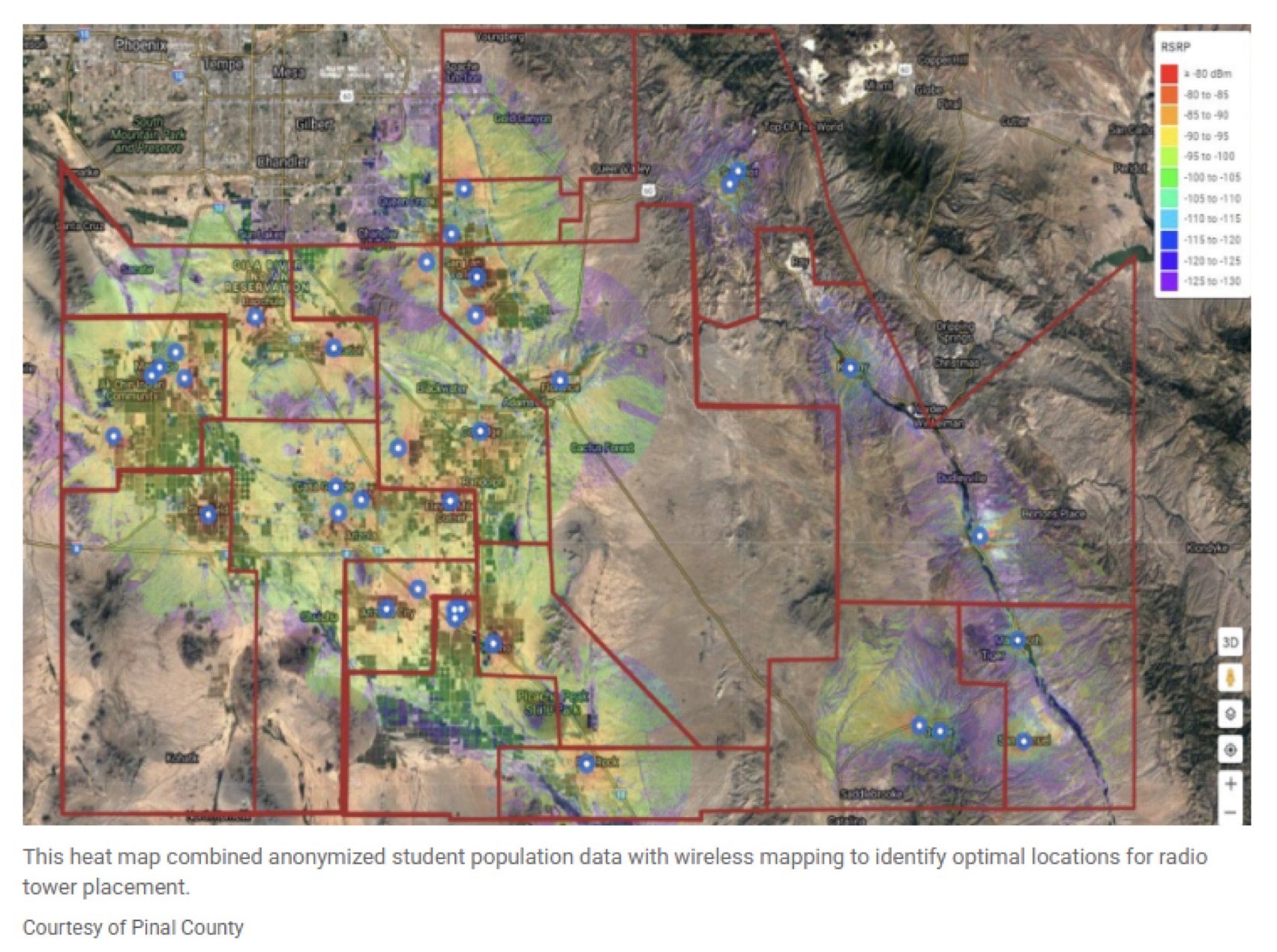
With towers located across the county, the network will provide seamless connectivity throughout the region, the team said, allowing students and authorized users to stay connected when at home, traveling between towns or participating in activities outside their usual study or work locations.
Once complete, the 32 radio sites — including 40-foot ground towers and 10-foot rooftop installations — will support a private LTE- and 5G-network. Most towers will be located on county or school district property, with additional sites at Central Arizona College and in the town of Mammoth, helping to reduce long-term costs.
“This is exactly how federal dollars should be used: efficiently, collaboratively and with a lasting impact for the people we serve,” U.S. Rep. Juan Ciscomani said in a comment to PinalCentral. By leveraging existing infrastructure, the project ensures that communities across Pinal County “aren’t left behind.”
“Reliable broadband is no longer a luxury,” he said. “It’s essential for education, public safety and economic opportunity, especially in our rural communities.”
The network is being built to support a wide range of uses. It will improve school bus Wi-Fi (which currently costs approximately $25 per bus and often provides inconsistent service), eliminate fees for licensed handheld radio frequencies and enable other learning and administrative functions.
Beyond educational applications, the network could also support traffic signal synchronization, flood sensors, smart agriculture, emergency management and other advanced systems.
For the first two years, outside experts will manage the system, allowing county staff to explore its full potential. Although tower construction is the current focus, planning for these future applications is expected to begin in the coming months.
Many stakeholders have already contributed to the project, and more are expected to join discussions to further expand its impact. The project team says the most challenging work — planning, coordinating lines and hookups and selecting the technology — is now complete. Construction is expected to progress smoothly, with the project tentatively scheduled for completion by next summer.
Pinal Board of Supervisors Chairman Steve Miller called the project “the culmination of years of work,” telling PinalCentral that it will make a meaningful difference in residents’ lives.


